




Antioxidants
Established in 1990, We are a professional manufacturer engaged in the research, development, production, sale and service of Rubber Accelerator, Antioxidant and other Rubber chemicals in int'l market.
Why Choose Us
World-wide expertise
We know international markets and trends. Our expertise, experience and network cover all corners of the world.
Competitive Price
We have professional sourcing team and cost accounting team, stive to reduce cost and profit and provide you a good price.
We always deliver on time
We genuinely understand the value of time in business and hence adhere to time and deliver all projects on time to our customers.
Customer Satisfaction
Providing after-sales services can enhance customer satisfaction by ensuring that customers' needs are met even after the purchase. This can lead to increased customer loyalty and positive word-of-mouth referrals.

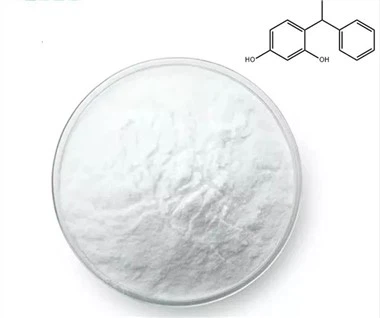




Resorcinol is an organic compound with the chemical formula C6H6O2. It is one of the three isomeric benzenediols which is white and soluble in water. It is also known as Resorcin or m-Dihydroxybenzene. It is a 1,3-isomer of benzenediol. It is a benzenediol that is benzene dihydroxylated at positions number 3 and 1. It functions as a sensitizer and an erythropoietin inhibitor.

M-Dihydroxybenzene can be synthesized in various ways. Some of them are discussed here.
Dialkylation of benzene with propylene to obtain 1,3-diisopropyl benzene. Hock rearrangement and oxidation of this obtained product gives resorcinol and acetone.
It can be produced by melting resins such as asafoetida, and galbanum with KOH (potassium hydroxide), or by the distillation process of Brazilwood extract.
It may be also prepared by melting benzene-1,3-disulfonic acid, phenol-3-sulfonic acid, 3-iodophenol, in the presence of potassium carbonate (K CO ) by the action of nitrous acid (HNO )
on 1,3-diaminobenzene or on 3-aminophenol. Many para and ortho compounds of the aromatic
series such as benzene-para-disulfonic acid, bromophenols also yield resorcinol on fusion with
KOH (potassium hydroxide).
Characteristics of Resorcinol
|
Key Properties of Resorcinol |
|
|
Name |
Resorcinol |
|
Also Known As |
Resorcin, m-Benzenediol, 3-Hydroxyphenol, 1,3-Benzenediol, 1,3-Dihydroxybenzene, m-Dihydroxybenzene |
|
State of Matter |
Solid (White) |
|
Chemical Composition |
C 6 H 4 (OH) 2 |
|
Melting Point |
110 °C |
|
Boiling Point |
277 °C |
|
Density |
1.28 g/cm 3 |
|
Molar Mass |
110.1 g/mol |
|
Water Solubility |
Soluble |
Uses of acetone
Uses of acetone in the industry – Medicine/ Pharmaceutical
Acetone is an organic solvent which is most commonly used in pharmaceuticals. It is used in producing pills and liquid medicines to have proper density. It is mandatory for the efficacy of the medicine. It is also used as an antiseptic. Acetone is used in the textile industry for degreasing wool and degumming silk.
Uses of acetone in cosmetics
Acetone denatures certain alcohol and is used as an additive in makeup and skin creams. One of the primary ingredients of nail paint remover is acetone. By using a cotton swab or cloth nail paint can be easily removed from nails and leaves it dry. Sometimes it can cause eye irritation or skin irritation.
Uses of acetone in the laboratory
Acetone is an important solvent in the laboratory. It is used to rinse the glass apparatus and makes the drying process faster. Its freezing point is -80 °C and is widely used to conduct chemical reactions at low temperatures. The vapours of acetone can be used as tracers because it appears fluorescent under UV light
Uses of acetone in electronics
It is used in cleaning electronic devices. Many electronic gadgets and appliance cleaners use acetone as a solvent.is used in the cleaning of electronic gadgets and devices
Uses of acetone for domestic purposes
It is used to remove oil stains from the walls.stubborn ink stains can be removed using acetone. It is used as a paint thinner for oil paints and resins and also can be used to clean brushes and other equipment that was used while painting
Difference Between Xylene and Acetone
The molar mass of acetone is about half that of xylene. Xylene can be found in the form of three different isomers whenever acetone is the simplest ketone available and it has no certain isomer. Xylene is considered non-polar in terms of polarity, but Acetone is slightly polar.
In terms of the solubility of xylene, it can be dissolved lipophilic compounds, but hydrophilic and lipophilic acetone can be dissolved.
Xylene is much more expensive and less toxic than acetone.


Chemical Properties Of Acetone
Acetone is a high level of miscibility in water, ethanol, ether, and methanol.
It is also colorless at room temperature and very sensitive to heat, so acetone evaporates quickly when it is in contact with air or sunlight if not stored properly.
Another property of acetone is that it is a very effective solvent for diluting a wide variety of dense chemicals. As it is highly volatile therefore it should be kept away from fire and high temperatures to reduce the potential for hazards.
Acetone is completely stable in the environment. And its chemical properties change markedly when mixed with water, which can cause sudden explosions when stored in airtight containers for a long time due to the accumulation of gases.
How is Acetone Recycled
Feed and Distillation: Waste acetone is deposited into the feed vessel. It then moves to the distillation vessel, where it is heated using thermal jackets with electric heaters. This raises the temperature to the boiling point. When the boiling point is reached, the acetone vaporizes.
Condensation: The acetone vapor travels into a condenser, where it is condensed and recovered as pure acetone.
Residual Waste: Any waste left in the distillation vessel after the process must be disposed of safely.

What is Acetone Made From
Acetone is a naturally occurring compound also known as propanone. Composed of the elements carbon, hydrogen, and oxygen, acetone presents as a clear liquid that is highly flammable and often used as cleaner in industrial settings.
Acetone is found in volcanic gases, plants, in byproducts of forest fires, and the breakdown of body fat. Acetone evaporates very quickly, and while it is produced in nature, for commercial use it is produced by manually combining three carbon atoms, six hydrogen atoms, and one oxygen atom to produce the compound element (CH3)2CO, that we call acetone.
Because acetone is both organic and non-toxic, when used properly, it is an element many products that people use every day. Acetone is the main ingredient in paint thinner, used as a solvent in various cosmetics and facial treatments, as well as a cleaning agent to remove sticky substances like glue or resin. Acetone is also used as an additive in gasoline that thins the gas allowing it to diffuse more easily through the engine, resulting in higher fuel efficiency.
What is acetone melting point and boiling point
Color and odor
Acetone is a very transparent liquid which has no color except in dark brown powder. The high flash point allows acetone to be easily ignited by an open flame such as a candle, with little chance of exploding or catching fire. This shows acetone melting point and boiling point.
Explosive properties and colorless flammable liquid when heated
Acetone's volatility causes it to dissolve in water, which is why it can cause injury upon contact with eyes or skin. Acetone also produces tear gas during combustion because the hydrocarbon component burns at temperatures above 800 ℃ (1472 ℉). Acetone is a very flammable substance that has a mild sweet odor. The mildness of this odor allows for its dissipation into the environment and for easy detection if spilled on the ground. In fact, this smell usually causes alarm in people because when it comes into contact with skin and eyes, evaporates quickly to form a thin layer of film over the affected tissue and then dries up to cause intense chemical burns.
Water solubility
Acetone is soluble in water and will dissolve in any water based substance with a PH greater than 7. Acetone's vapor pressure is approximately 17 atm at 25 ℃ (77 ℉) so it can easily be removed from water through evaporation. In fact, the flammability of acetone can even be used as a means of removing water from some substances. Since acetone is a reasonably good solvent for oil and fats, it is often added to other substances to prevent them from solidifying into clumps on freezing.
Melting point, boiling point, and freezing point
Acetone has a very low melting point which is 0 ℃ (32 ℉). The boiling point of acetone is 78.6 ℃ (173.3 ℉) while its freezing point is -90.8 ℃ (-128 ℉). This means it is a liquid under normal conditions but under high pressure, acetone is also known to exist in a gas state.
Vapor pressure
The vapor pressure of acetone in the atmosphere is approximately 17 atm at 25 ℃ (77 ℉). The low vapor pressure makes it hard for molecules to escape the surface of a liquid state to become a vapor and thus make the liquid evaporate easily. This property allows acetone to dissolve some substances into its water-like form yet maintain the ability to evaporate quickly when excess heat is applied or too much solvent has been added to remove solids from solutions.

Safety Tips for Working with Acetone
Make sure you are wearing chemical safety goggles and a shield.
Wear chemically protected clothing like gloves, boots, aprons, and avoid prolonged contact.
Make sure the area is well ventilated.
Make sure the place is dry enough so that the surface does not soak the liquid.
Keep the fire extinguisher with you.
Don't mix other compounds or solvents with Acetone.
Work in a well-ventilated area, so there is no inhalation of the fumes.
Keep the windows open when you paint.
Do not smoke or use any type of open flame in the area that is exposed to acetone fumes.
Make sure there are no open flames or heat sources near you.
Do not store chlorine or bleach in the same location as Acetone.
Don't use your acetone container as a wastebasket.
Do not try to store Acetone in plastic containers as it will dissolve the container over time and corrode metals.
What is the treatment for acetone poisoning
There is no “cure” for acetone poisoning. But doctors can give supportive care while your body clears the ketones from your system. Your body’s natural response is to raise the breathing rate to get rid of the acids that have accumulated in the blood. Your doctor may insert a tube in your airway (intubation) to help you breathe. If you’re critically ill, you may also need blood pressure support to maintain an adequate oxygen supply to your organs. Often, doctors will also give fluids.
You shouldn’t induce vomiting if you’ve drunk large amounts of acetone. Acetone is harmful to the skin in your mouth and the lining of your esophagus. Your doctor can pump your stomach by putting a tube down your throat and into your stomach. They then pump small amounts of water or saline into your stomach and suck it back out until there’s no more acetone. However, because acetone is so quickly absorbed, this method is only effective within the first hour of ingestion.
Stomach pumping raises the risk of accidental aspiration pneumonia, a condition in which the water is accidentally pumped into the lungs instead of the stomach. A person can drown from the liquid filling their lungs.
Our Factory
We have obtained ISO9001 certificates. Our products have been exported to 57 countries. Our export turnover is more than 36 million US dollars per year.

FAQ
Q: What is resorcinol used for?
Comment on the antibacterial and antifungal properties of resorcinol
The antibacterial and antifungal activities may result from protein precipitation. However, the keratolytic activity may contribute to the antifungal effect, as removal of the stratum corneum suppresses fungal growth. Absorption: Resorcinol can be absorbed from ulcerated surfaces or via the skin.
Q: What is resorcinol derived from?
Q: What do you use acetone for?
Q: Is acetone harmful to humans?
Q: Is acetone nail polish remover?
Q: What is acetone also known as?
Q: Is acetone an alcohol?
Q: Can I use xylene instead of acetone?
Q: What solvent is stronger than acetone?
Q: What is the common name for dihydroxy benzene?
Q: What is the medical importance of dihydroxy benzene?
Q: Is acetone highly flammable?
Q: What is the explosive limit of acetone?